
Depave LA: The Data-Driven Case for Removing Excess Pavement
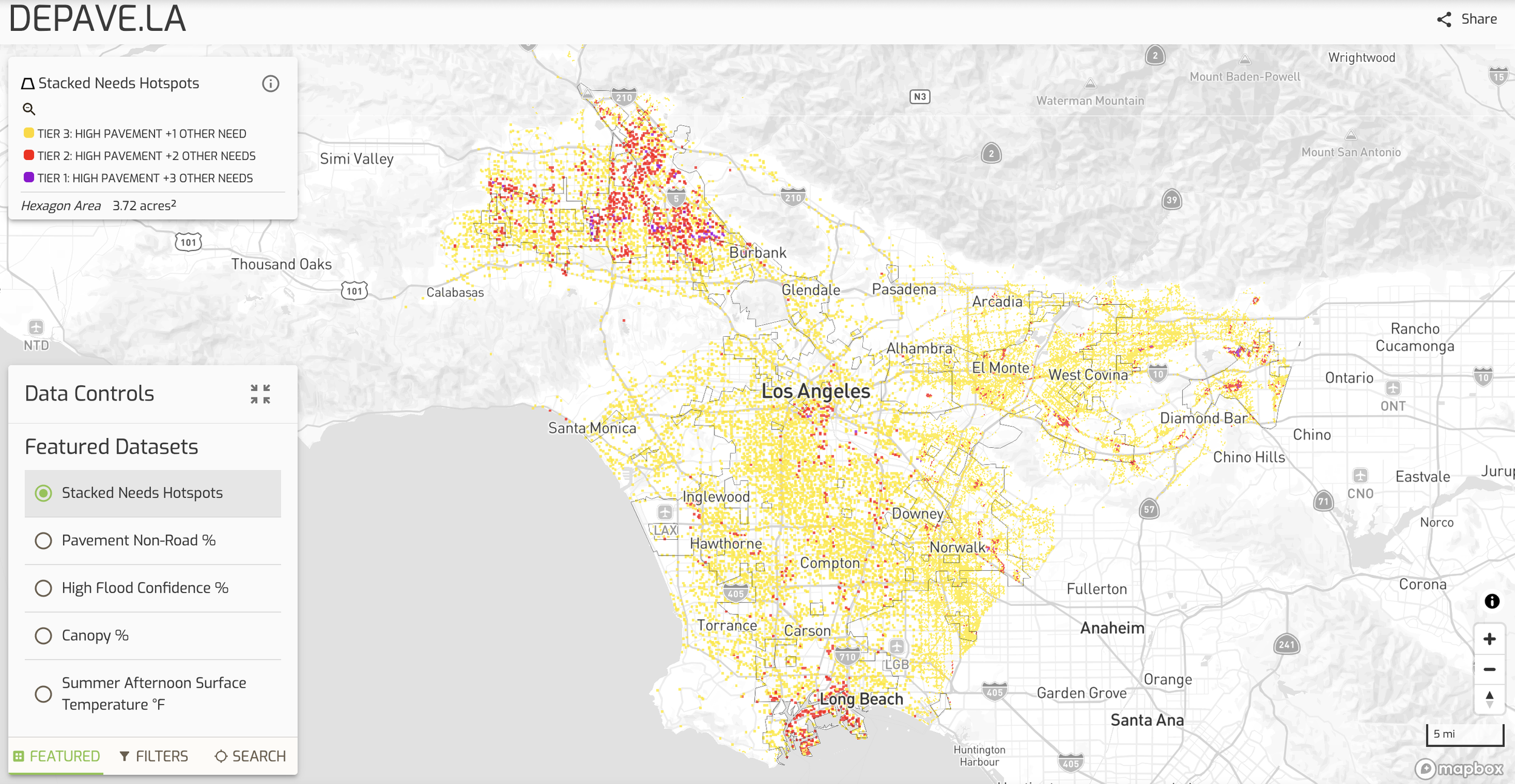
Depave LA is a collaborative report between Accelerate Resilience L.A. (ARLA) and Hyphae Design Laboratory that reimagines Los Angeles through a transformative block-by-block approach to adapting from a city of pavement to one of climate-resilience. On February 18, these speakers from ARLA and Hyphae hosted a webinar celebrating the release of the report:
Devon Provo, Senior Manager of Planning and Program Alignment (ARLA)
Deborah Bloom, Senior Policy Director (ARLA)
Brent Bucknum, Founder (Hyphae)
Daniel Fleischer, Chief Science Officer (Hyphae)
For the last 100 years pavement has equaled progress — it has created roads for transportation, foundations for enormous cities, and housing to accomodate our growing population — converting the once luscious city of Los Angeles into a concrete jungle. But with these changes also came extreme heat, flooding, and a disproportionate impact on disadvantaged communities. Furthermore, excess pavement can negatively affect community identity, mental health, air quality and pollution exposure, perceptions of safety, and social cohesion. As environmental pressures accelerate in LA county, removing unnecessary pavement has become an urgent need — one that will require both immense physical changes as well as a shift in culture.
After conducting a detailed analysis of the pavement across LA County, the report revealed that up to 44% of the county’s 488 square miles of pavement may not be functionally necessary. It also revealed that 70% of this excess pavement sits on privately owned land parcels, including 22 square miles on vacant parcels, and that 79% of identified depaving hotspots are located in communities designated as disadvantaged under SB 535.
To focus depaving where it will create the most impact, the researchers conducted a needs-based assessment to identify priority locations for pavement removal. By examining four key vulnerability areas — high pavement burden, flood risk, limited tree canopy, and extreme heat — the report identifies “Stacked Needs Hotspots” across the county that that stand to benefit most from depaving. The analysis estimates costs from $9-$15 per square foot of land depaved, or up to $100-$160 when including planting and landscape restoration.
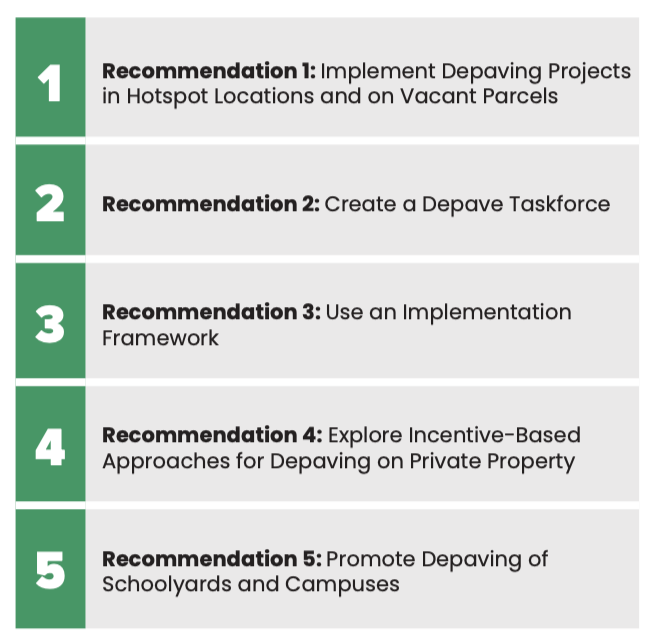
Based on these findings, Depave LA presents five targeted recommendations offering guidance for future policy and implementations.
Implement Depaving Projects in Hotspot Locations and on Vacant Parcels
Create a Depave Taskforce
Use an Implementation Framework
Explore Incentive-Based Approaches for Depaving on Private Property
Promote Depaving of Schoolyards and Campuses
Together, these recommendations provide a clear roadmap for turning data into action and accelerating depaving efforts across Los Angeles.
To learn more about Depave LA, visit their website and explore the interactive data viewer, which features a detailed map of Los Angeles County and highlights stacked needs hotspots through adjustable layers, boundaries, and categories.