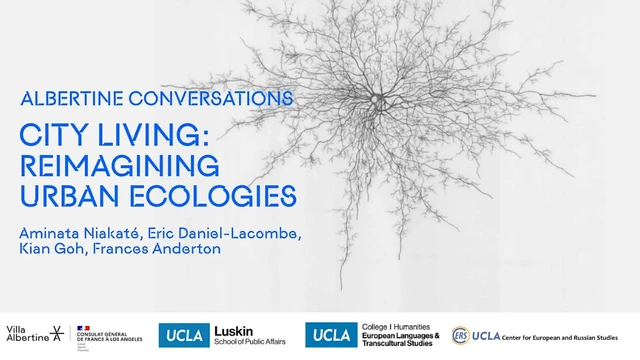
On October 13th, 2026, UCLA hosted French and American scholars, policymakers, and urban-design leaders in this dynamic and innovative panel conversation on “City Living: Reimagining Urban Ecology,” co-hosted by Villa Albertine, UCLA’s Center for European and Russian Studies, the Department of European Languages and Transcultural Studies, and the Luskin School of Public Affairs.
This discussion explored real-world projects and examples from abroad, impacts, and future outlooks aimed at transforming major global hubs like Paris and Los Angeles into more sustainable, livable, and resilient urban environments.
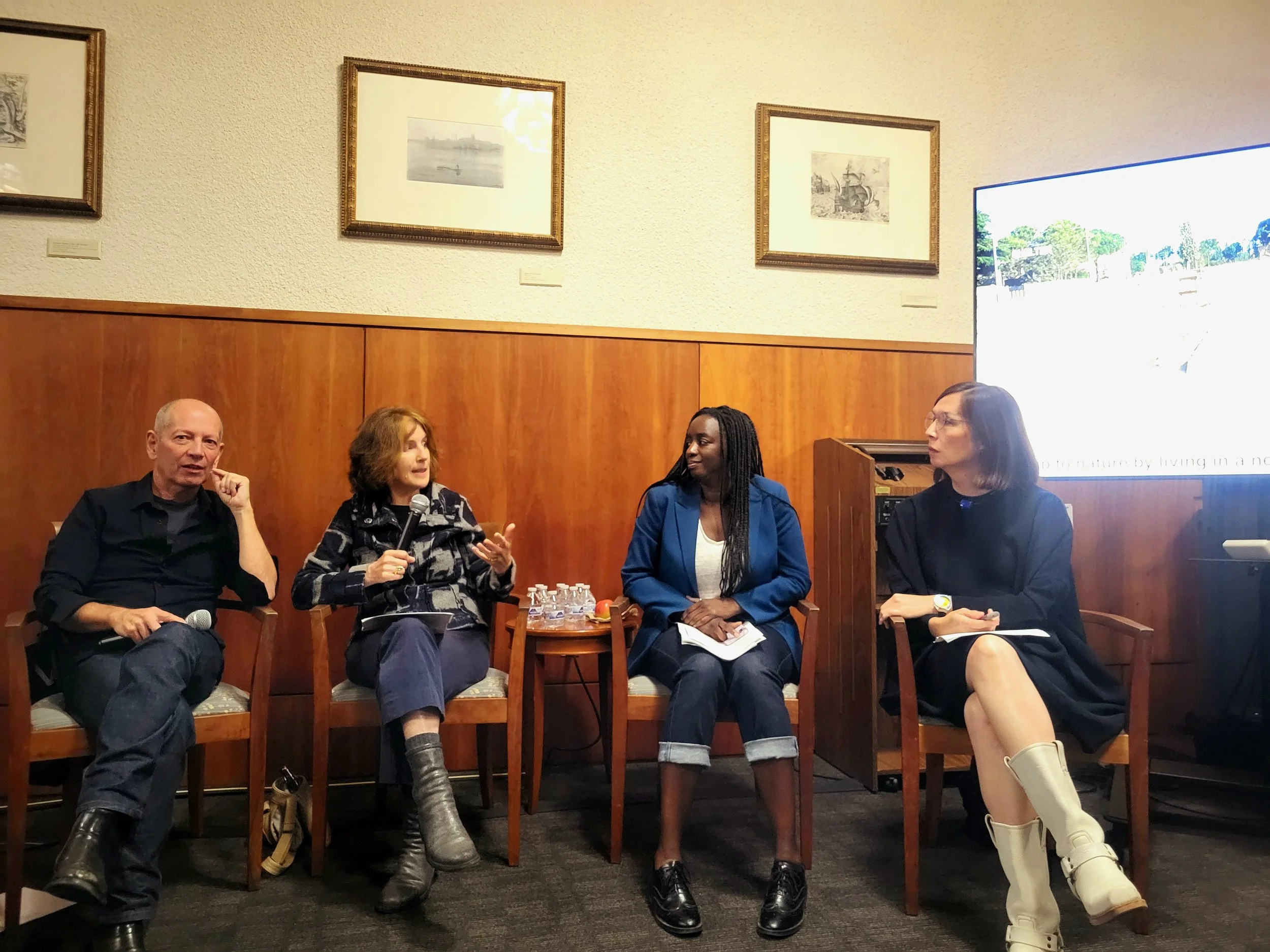
This panel featured (from left to right):
Éric Daniel-Lacombe, architect, urbanist, author, and Chair in “New Forms of Urban Living in the Face of Natural Disasters” at ENSAP;
Frances Anderton, writer, broadcaster, curator, and former host of KCRW’s DnA: Design and Architecture, who moderated the conversation.
Aminata Niakaté, Deputy Mayor of Paris for green development and biodiversity;
Kian Goh, Associate Professor of Urban Planning at the UCLA Luskin School of Public Affairs
The conversation started by highlighting Paris’ “Garden City” initiative, which began before the city hosted the 2024 Olympics. The initiative aims to reverse decades of urban paving by replacing roads and parking spaces with bike lanes and green spaces, providing residents with greater access to nature and relief from heatwaves. Since 2020, the City of Paris has reportedly replaced 13,000 parking spaces with more than 100,000 native trees selected for their heat tolerance, helping make the city 7.2˚F to 18˚F cooler. Given Paris’ limited reliance on and lack of widespread air conditioning, this temperature reduction has had a tangible impact on residents’ comfort, which strengthened support for the initiative. Implementing these changes in schoolyards was identified as a particularly effective strategy for demonstrating their benefits, including increased shade, safer environments with fewer cars, and improved access to nature. These successes could serve as models for similar transformations across the city.
Furthermore, the panel emphasized the importance of reconnecting urban environments with nature through climate-adaptive approaches, such as the “Open Shelter” model. Architect Éric Daniel-Lacombe applied this approach in Aude, France, to address the threat of deadly flooding. The project involved removing a group of houses, an artificial lake, and other infrastructure to allow the adjacent Trapel River to flow more freely and accommodate floodwaters before they reached the city. Beyond improving flood management, the restored landscape serves multiple purposes: it creates a natural firebreak, provides space for trees and shade, and offers a beach where residents can gather and enjoy the outdoors. This project demonstrates how climate adaptation can simultaneously improve public safety, restore natural systems, and enhance community spaces.
Lastly, the discussion returned to Los Angeles, where the fragmented network of governing bodies presents a significant obstacle to implementing similar large-scale initiatives. This complex governance structure has contributed to delays in projects such as the revitalization of the LA River, while neighborhoods remain vulnerable to wildfires and other climate-related risks. With the 2028 Olympic Games approaching, the panel underscored the need for both top-down leadership and bottom-up community action to accelerate urban transformation. Ultimately, creating more sustainable and resilient cities requires rethinking how urban spaces are designed and governed to improve public safety and reconnect communities with the natural environment, both above and beneath the city.